
Enables systematic, dependency-aware scenario exploration for group sequential designs created by gsDesign. gsDesignTune is built for design-space evaluation (ranking, filtering, Pareto trade-offs) rather than claiming a single “optimal design”. With a focus on user experience, correctness, and speed, it supports off-the-shelf parallel processing with progress tracking, caching, and reproducible reporting.
You can install the development version of gsDesignTune from GitHub with:
# install.packages("pak")
pak::pak("nanxstats/gsDesignTune")gsDesign()/gsSurv()/gsSurvCalendar()
with
gsDesignTune()/gsSurvTune()/gsSurvCalendarTune(),
then $run().Evaluate time-to-event designs:
library(gsDesign)
library(gsDesignTune)
library(future)

plan(multisession, workers = 2)

job <- gsSurvTune(
  k = 3,
  test.type = 4,
  alpha = 0.025,
  beta = 0.10,
  timing = tune_values(list(c(0.33, 0.67, 1), c(0.5, 0.75, 1))),
  hr = tune_seq(0.55, 0.75, length_out = 5),
  upper = SpendingFamily$new(
    SpendingSpec$new(sfLDOF, par = tune_fixed(0)),
    SpendingSpec$new(sfHSD, par = tune_seq(-4, 4, length_out = 9))
  ),
  lower = SpendingSpec$new(sfLDOF, par = tune_fixed(0)),
  lambdaC = log(2) / 6,
  eta = 0.01,
  gamma = c(2.5, 5, 7.5, 10),
  R = c(2, 2, 2, 6),
  T = 18,
  minfup = 6,
  ratio = 1
)

job$run(strategy = "grid", parallel = TRUE, seed = 1, cache_dir = "gstune_cache")

res <- job$results()
head(res)

job$best("final_events", direction = "min")
job$pareto(metrics = c("final_events", "upper_z1"), directions = c("min", "min"))

job$plot(metric = "final_events", x = "hr", color = "upper_fun")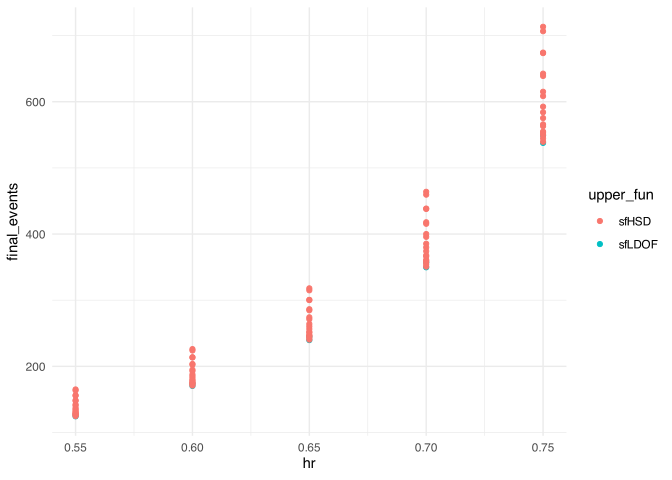
job$report("gstune_report.html")tune_fixed(x): explicit fixed value (useful inside
dependencies)tune_values(list(...)): explicit candidates (supports
vector-valued candidates)tune_seq(from, to, length_out),
tune_int(from, to, by)tune_choice(...): categorical choicestune_dep(depends_on, map): dependent mapping for any
argumentSee vignettes for end-to-end examples, spending function tuning, and parallel + reproducible reporting.