

Country data onto honest maps: joined on ISO codes, never on country names.
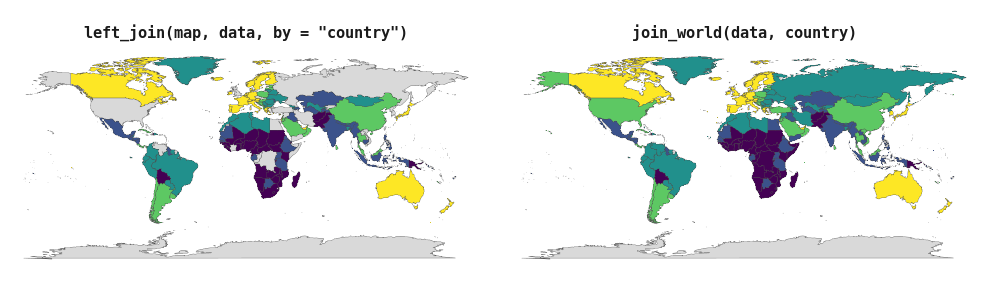
Join the World Bank’s life-expectancy table to
map_data("world") by country name and 37 of 210
countries silently vanish: nobody spells Czechia, Côte d’Ivoire
or "Congo, Dem. Rep." the same way twice.
countryatlas makes the ISO code the join key, so nothing
goes missing, then draws the map.
install.packages("countryatlas")                            # CRAN
pak::pak("PursuitOfDataScience/countryatlas")               # development
The base install is light. Every heavy spatial dependency
(sf, cartogram, leaflet, …) is a
Suggests you only need for the feature that uses it.
world_data() fetches the indicator, attaches the
geometry and keys the whole thing on iso3c: three worlds
(ggplot2 maps, WDI, countrycode)
stitched together in one line.
world_map(world_data(2020), gdp_per_capita, style = "quantile")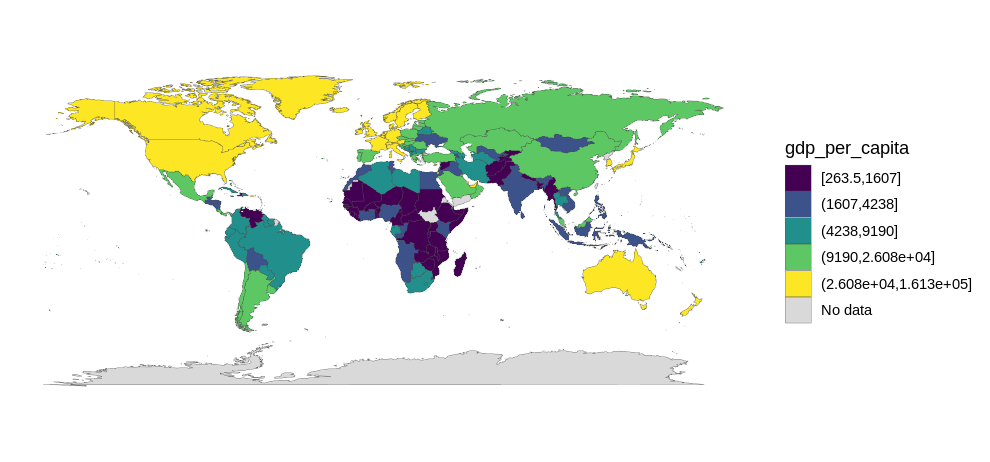
world_data(2020, c(life_exp = "SP.DYN.LE00.IN")) |>
  glimpse()
#> Rows: 99,338
#> Columns: 12
#> $ long      <dbl> -69.89912, -69.89571, -69.94219, -70.00415, -70.06612, -70.0…
#> $ lat       <dbl> 12.45200, 12.42300, 12.43853, 12.50049, 12.54697, 12.59707, …
#> $ group     <dbl> 1, 1, 1, 1, 1, 1, 1, 1, 1, 1, 2, 2, 2, 2, 2, 2, 2, 2, 2, 2, …
#> $ order     <int> 1, 2, 3, 4, 5, 6, 7, 8, 9, 10, 12, 13, 14, 15, 16, 17, 18, 1…
#> $ subregion <chr> NA, NA, NA, NA, NA, NA, NA, NA, NA, NA, NA, NA, NA, NA, NA, …
#> $ iso3c     <chr> "ABW", "ABW", "ABW", "ABW", "ABW", "ABW", "ABW", "ABW", "ABW…
#> $ iso2c     <chr> "AW", "AW", "AW", "AW", "AW", "AW", "AW", "AW", "AW", "AW", …
#> $ country   <chr> "Aruba", "Aruba", "Aruba", "Aruba", "Aruba", "Aruba", "Aruba…
#> $ continent <chr> "Americas", "Americas", "Americas", "Americas", "Americas", …
#> $ region    <chr> "Latin America & Caribbean", "Latin America & Caribbean", "L…
#> $ income    <fct> High income, High income, High income, High income, High inc…
#> $ life_exp  <dbl> 75.406, 75.406, 75.406, 75.406, 75.406, 75.406, 75.406, 75.4…
Geometry, codes, classifications and the indicator, in one frame,
ready for world_map().
Drop geometry for a plain country table
(country_data()), ask for a year range to get a panel, or
pass several indicators at once. wdi_search() finds codes
offline; common_indicators keeps the 22 you actually
use.
Point join_world() at whatever column holds the country
and it standardises, joins and attaches geometry in one go.
tibble(
  nation = c("U.S.", "S. Korea", "Czechia", "Kosovo", "Cote d'Ivoire", "Burma"),
  score  = c(10, 8, 6, 4, 7, 5)
) |>
  join_world(nation, warn = FALSE) |>
  world_map(score, title = "Six countries, six spellings, one map")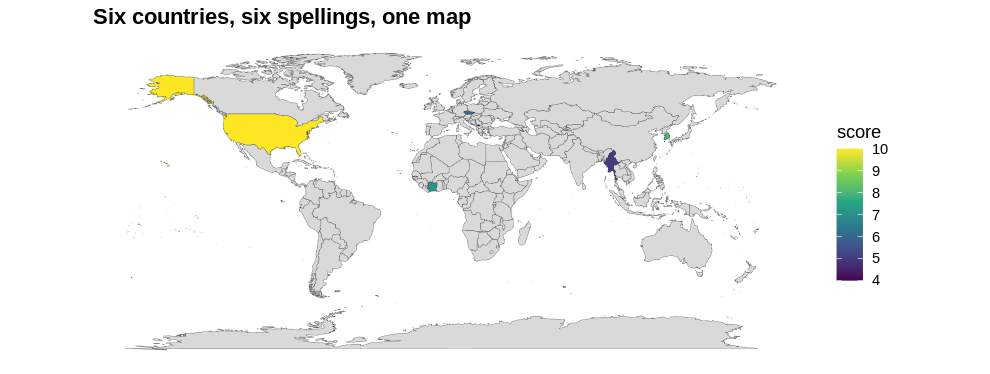
Two messy tables reconcile against each other the same way:
a <- tibble(country = c("Czechia", "South Korea"), gdp = c(1, 2))
b <- tibble(nation  = c("Czech Republic", "Korea, Rep."), pop = c(10, 51))
country_join(a, b, country, nation)
#> # A tibble: 2 × 5
#>   country       gdp iso3c nation           pop
#>   <chr>       <dbl> <chr> <chr>          <dbl>
#> 1 Czechia         1 CZE   Czech Republic    10
#> 2 South Korea 2 KOR Korea, Rep. 51check_country_match() reports before you join, including
the entities countrycode resolves wrongly rather
than not at all.
check_country_match(c("USA", "Cote d'Ivoire", "USSR", "Wakanda"))
#> # A tibble: 4 × 5
#>   input         iso3c matched historical suggestion
#>   <chr>         <chr> <lgl>   <lgl>      <chr>
#> 1 USA           USA   TRUE    FALSE      <NA>
#> 2 Cote d'Ivoire CIV   TRUE    FALSE      <NA>
#> 3 USSR          RUS   TRUE    TRUE       <NA>
#> 4 Wakanda       <NA>  FALSE   FALSE      Canada
repair_country_names() fixes typos,
audit_coverage() grades a finished join, and
dissolve_country() expands a dead state into its
successors.
dissolve_country("Yugoslavia")
#> # A tibble: 7 × 5
#>   input      historical dissolved iso3c country
#>   <chr>      <chr>          <int> <chr> <chr>
#> 1 Yugoslavia Yugoslavia      1992 BIH   Bosnia & Herzegovina
#> 2 Yugoslavia Yugoslavia      1992 HRV   Croatia
#> 3 Yugoslavia Yugoslavia      1992 MKD   North Macedonia
#> 4 Yugoslavia Yugoslavia      1992 MNE   Montenegro
#> 5 Yugoslavia Yugoslavia      1992 SRB   Serbia
#> 6 Yugoslavia Yugoslavia      1992 SVN   Slovenia
#> 7 Yugoslavia Yugoslavia 1992 XKX KosovoEvery map below is one function call on the bundled offline snapshot.
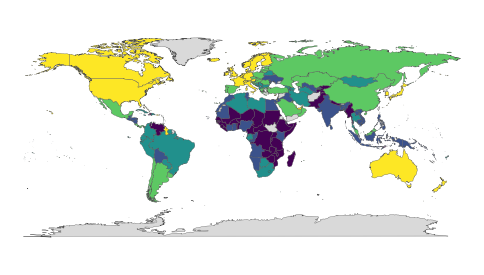 world_map(d,
gdp_per_capita, style = “quantile”)
|
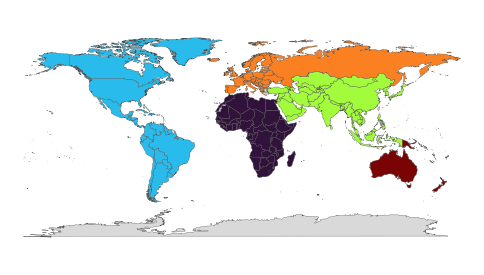 world_map(d,
continent, style = “categorical”)
|
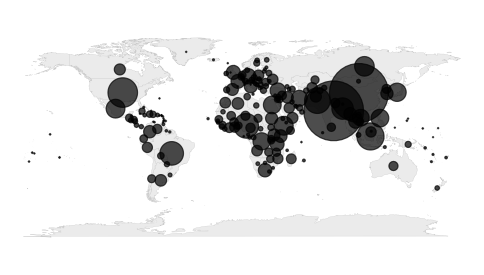 bubble_map(d,
population)
|
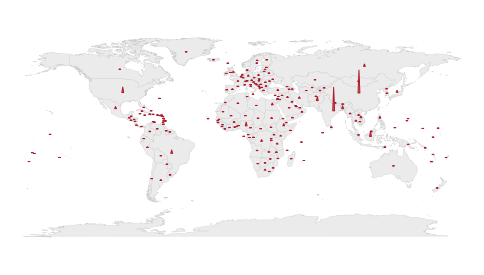 spike_map(d,
population)
|
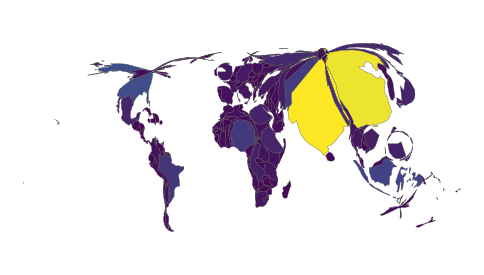 cartogram_map(d,
population)
|
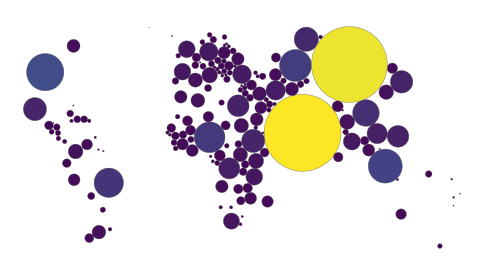 dorling_map(d,
population)
|
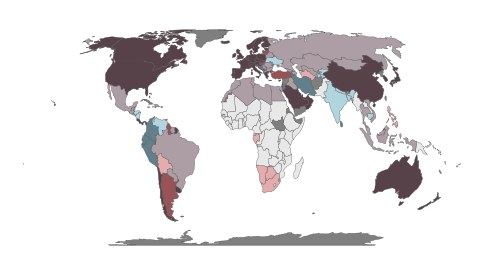 bivariate_map(d,
gdp_per_capita, life_expectancy)
|
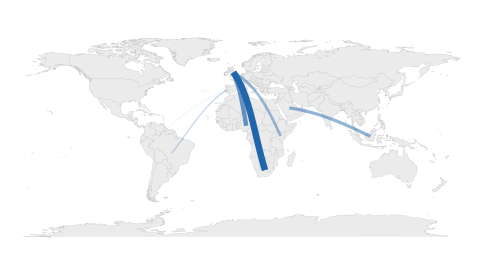 flow_map(corridors,
from, to, people)
|
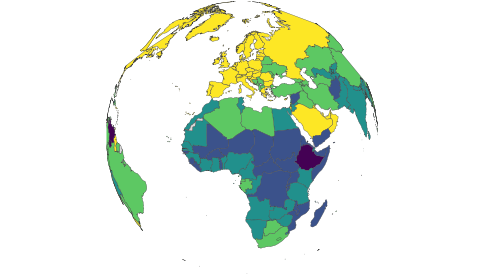 globe_map(d,
income, style = “categorical”)
|
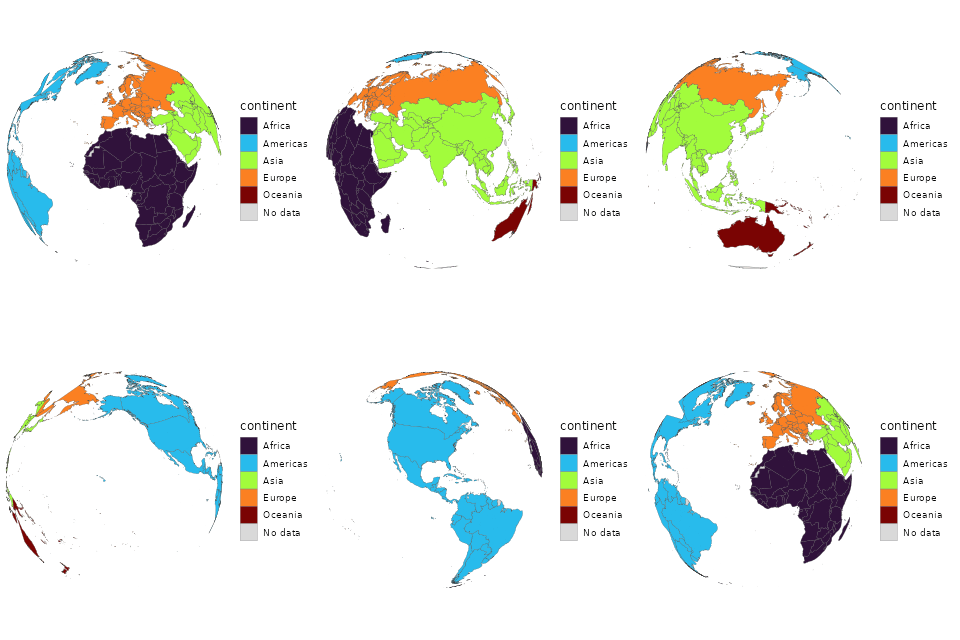 spin_globe(d,
continent, style = “categorical”)
|
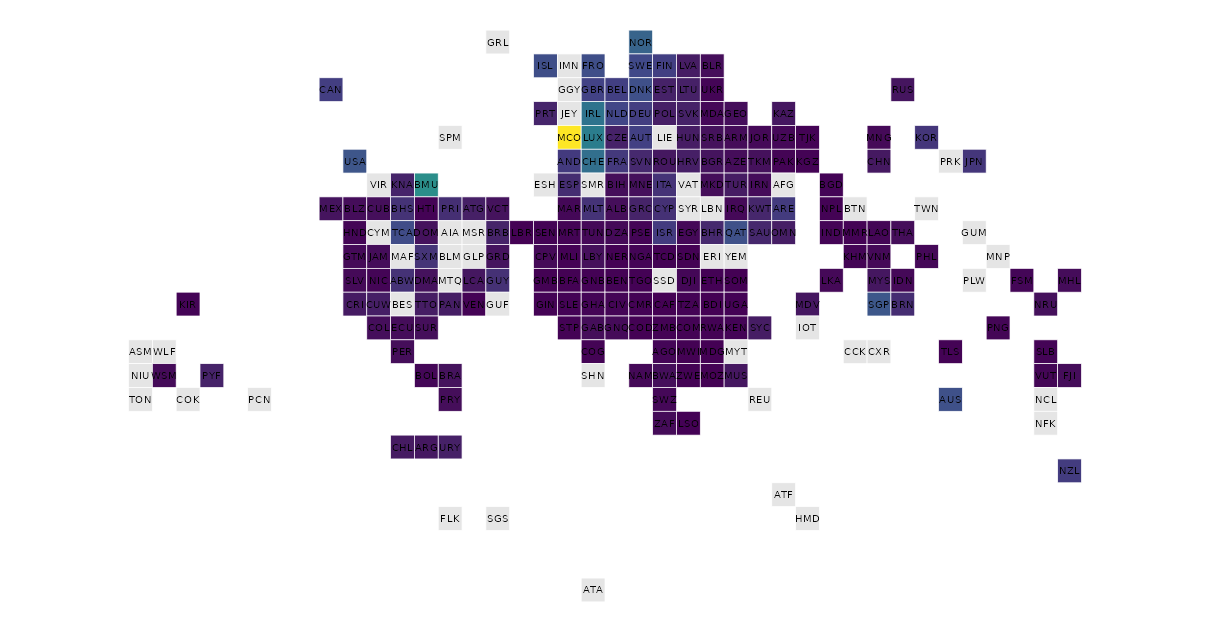 tile_map(d,
gdp_per_capita): one square per country, so microstates are as
visible as Russia
|
|
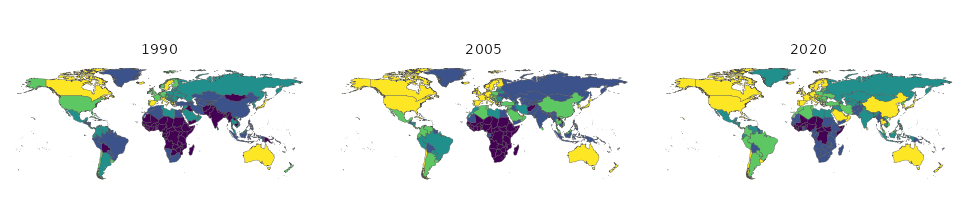 facet_map(panel,
life_exp, year, style = “quantile”), or
animate_world(panel, life_exp) for the moving version
|
|
interactive_map() hands the same frame to
plotly, ggiraph,
leaflet or ggsql for a web-ready
widget. With as_ggsql_source() and
world_query() the drawing happens inside DuckDB:
countryatlas reconciles the countries and ggsql renders them without ggplot2 or
sf at runtime.
“Honest maps” is in the package description, so the package has to earn it. Four ways a world map misleads, the verb for each, and one more that makes the map admit what it did.
Your classification is doing the talking. Equal-interval breaks put 92% of countries in one class here; quantiles spread them evenly. Same data, same palette, opposite conclusions.
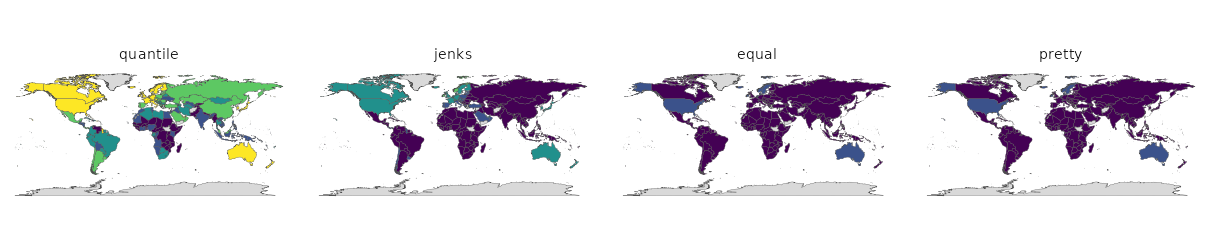
p <- classify_compare(poly, gdp_per_capita)
attr(p, "countryatlas_classification") |> filter(method %in% c("quantile", "equal"))
#> # A tibble: 10 × 4
#>    method   class                     n   share
#>    <chr>    <chr>                 <int>   <dbl>
#>  1 quantile [268.7,1662]             38 0.201
#>  2 quantile (1662,4594]              38 0.201
#>  3 quantile (4594,1.029e+04]         37 0.196
#>  4 quantile (1.029e+04,2.937e+04]    38 0.201
#>  5 quantile (2.937e+04,2.472e+05]    38 0.201
#>  6 equal    [268.7,4.965e+04]       173 0.915
#>  7 equal    (4.965e+04,9.903e+04]    13 0.0688
#>  8 equal    (9.903e+04,1.484e+05]     2 0.0106
#>  9 equal    (1.484e+05,1.978e+05]     0 0
#> 10 equal    (1.978e+05,2.472e+05]     1 0.00529
Your projection is doing the talking too. Tissot’s indicatrix puts circles of equal ground radius on the map: whatever the projection does to them, it is doing to your data.
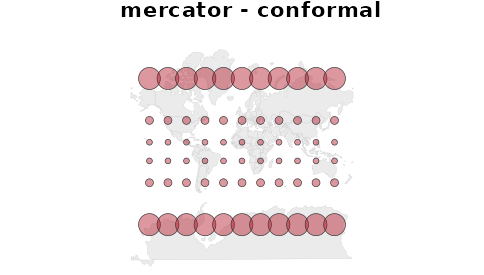 tissot_map(“mercator”):
shapes right, areas wildly wrong
|
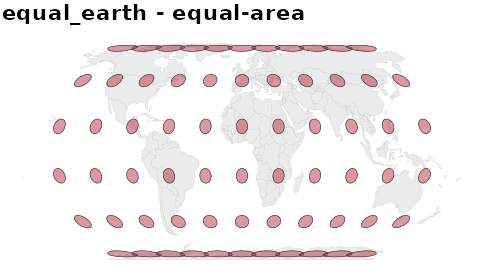 tissot_map(“equal_earth”):
areas right, shapes sheared
|
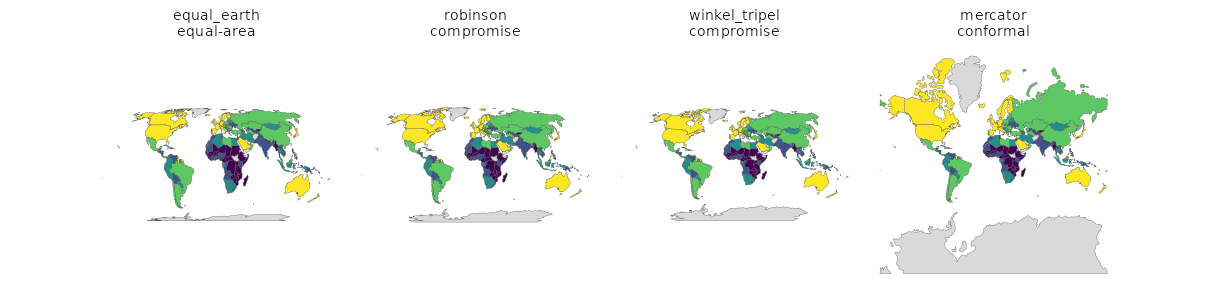 projection_compare(d,
gdp_per_capita), and projection_info() for which of
the thirteen are equal-area
|
|
Grey means “no data”, but it reads as “low”. Hatch the gaps so nobody mistakes them for a value, or map availability itself.
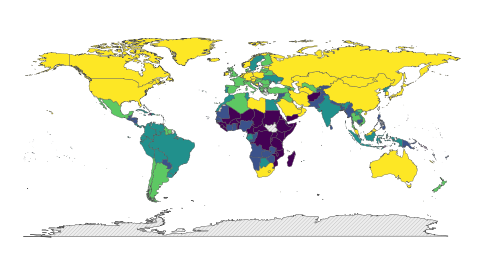 world_map(d,
co2_per_capita, na_style = “hatched”)
|
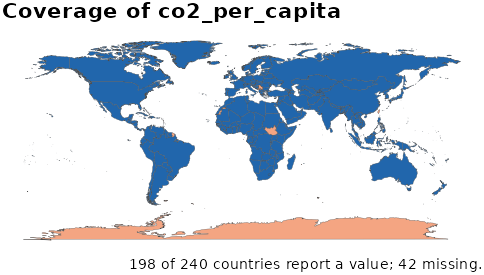 coverage_map(d,
co2_per_capita)
|
A rate over eleven thousand people should not shout as loudly as one over a billion. Value-by-alpha spends opacity on the denominator, so small-population countries recede: the cartogram’s answer to the same problem, without distorting the geometry.
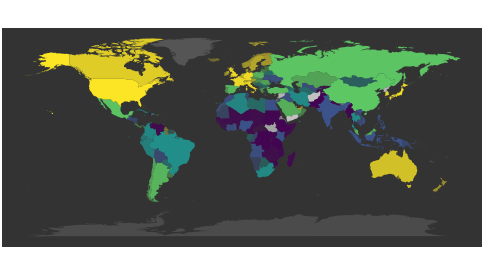
value_by_alpha_map(d, gdp_per_capita, population)And the map should say what it is.
footnote = "auto" writes the coverage line;
map_provenance() answers the questions a reviewer asks
first.
world_map(poly, gdp_per_capita, style = "quantile",
          na_style = "hatched", footnote = "auto") |>
  map_provenance()
#>
#> ── countryatlas map provenance
#> package: countryatlas 3.0.0 (snapshot 2024)
#> fill: gdp_per_capita
#> geometry: polygon backend, coord_quickmap
#> classification: quantile, 5 bins
#> missing data: hatched
#> coverage: 189 countries shown, 51 missing
#> breaks: 268.7 | 1662 | 4594 | 10290 | 29370 | 247200The ISO spine is not only the World Bank’s, and not only 2024’s.
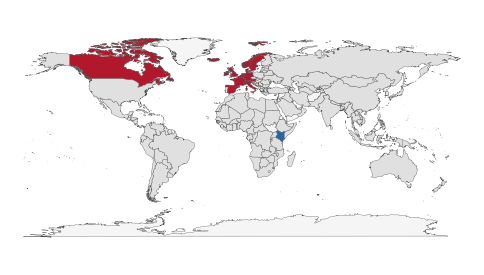
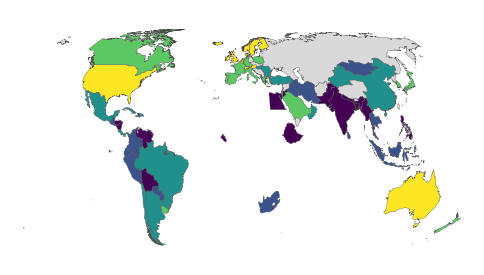 attach_geometry(d,
year = 1950): 1950 borders, via CShapes. Africa is nearly empty
because in 1950 almost none of it was sovereign; pass dependencies
= TRUE for the colonies.
|
 lisa_map(d,
gdp_per_capita, weights = country_weights(“knn”))
|
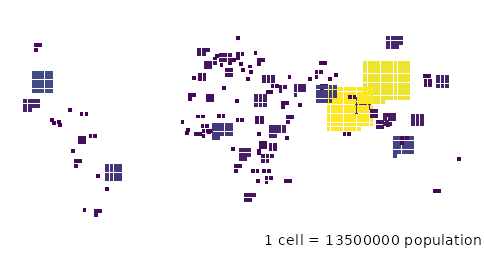 gridded_cartogram(d,
population): one cell per N people, countable
|
value_by_alpha_map(d,
gdp_per_capita, population)
|
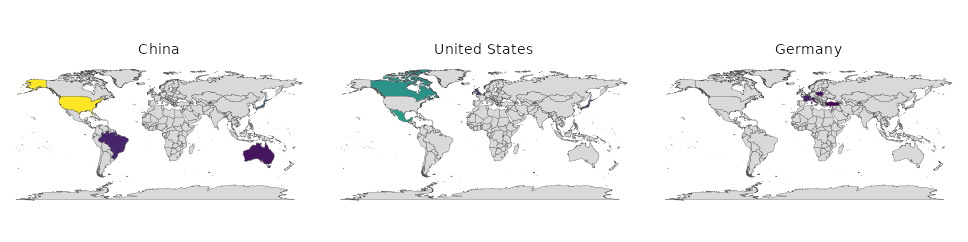 od_map(flows,
from, to, value): where each origin sends, when
flow_map() would be spaghetti
|
|
Membership is a function of time, and a snapshot quietly misstates any panel that spans an accession:
c(`2016` = in_group("United Kingdom", "EU", as_of = 2016),
  `2021` = in_group("United Kingdom", "EU", as_of = 2021))
#>  2016  2021
#>  TRUE FALSE
Islands have no land border, so the default
contiguity weights drop a quarter of the world from a “global” Moran’s
I. country_weights() fixes it, and the result says how many
it dropped either way:
snap <- world_snapshot$countries
cols <- c("i", "n", "n_excluded")
rbind(
  cbind(scheme = "contiguity",
        morans_i(snap, gdp_per_capita, n_perm = 0)[cols]),
  cbind(scheme = "knn",
        morans_i(snap, gdp_per_capita, n_perm = 0,
                 weights = country_weights("knn", k = 5))[cols])
)
#>       scheme         i   n n_excluded
#> 1 contiguity 0.6073182 142         49
#> 2        knn 0.4720522 189          2
Any provider, one shape.
register_country_source() takes a fetch function and a
name; fetch_indicator() and compare_sources()
do the rest, including telling you where two providers disagree.
country_sources()[, c("source", "meta")]
#> # A tibble: 5 × 2
#>   source   meta
#>   <chr>    <chr>
#> 1 comtrade UN Comtrade bilateral trade (via comtradr); needs an API token
#> 2 eurostat Eurostat (via eurostat); European coverage only
#> 3 oecd     OECD statistics (via OECD)
#> 4 owid     Our World in Data (via owidR)
#> 5 wdi World Bank World Development Indicators (via WDI)snap <- world_snapshot$countries
# inequality between people, not between country units
gini(snap$gdp_per_capita, weights = snap$population)
#> [1] 0.6094909
# how much of it sits between continents rather than within them
theil(snap$gdp_per_capita, weights = snap$population, groups = snap$continent)
#> # A tibble: 3 × 3
#> component value share
#> <chr> <dbl> <dbl>
#> 1 total 0.678 1
#> 2 between 0.310 0.458
#> 3 within 0.368 0.542
# who borders whom, and how far apart they are -- no sf required
distance_between("France", "Germany")
#> [1] 802.3524
convert_country(c("Japan", "Brazil"), to = "flag")
#> [1] "🇯🇵" "🇧🇷"| Assemble | world_data() country_data()
world_geometry() attach_geometry()
clear_country_cache() |
| Other sources | register_country_source()
remove_country_source() country_sources()
fetch_indicator() add_indicator()
compare_sources() fetch_owid()
fetch_eurostat() fetch_oecd()
fetch_comtrade() |
| Join | standardize_country() join_world()
country_join() country_join_all()
dissolve_country()
standardize_subnational() |
| Diagnose | check_country_match()
repair_country_names() audit_coverage()
audit_time_coverage() rate_check()
check_dispute_coverage()
country_overrides() |
| Look up | convert_country() country_codes()
country_groups() in_group()
wdi_search() |
| Compute | per_capita() share_of_world()
growth_rate() index_to()
rank_countries() aggregate_regions()
complete_years() lag_by_country()
diff_by_country() correlate_indicators()
deflate() to_ppp() smooth_rates()
interpolate_missing() |
| Measure spread | gini() theil()
beta_convergence() sigma_convergence()
convergence_club() |
| Spatial statistics | country_weights() morans_i()
local_morans() lisa_map()
gearys_c() getis_ord()
spatial_lag() |
| Locate | locate_country() neighbors()
country_borders() distance_between()
simplify_geometry() nuts_geometry() |
| Travel in time | historical_geometry() country_timeline()
country_groups(as_of=) in_group(as_of=) |
| Relate | flow_matrix() country_network()
od_map() |
| Draw | world_map() globe_map()
spin_globe() facet_map()
bubble_map() spike_map()
bivariate_map() cartogram_map()
dorling_map() value_by_alpha_map()
tile_map() flow_map()
animate_world() interactive_map()
gridded_cartogram() subnational_map()
geom_country_labels() theme_world_map() |
| Keep honest | classify_compare() coverage_map()
projection_info() projection_compare()
projection_distortion() tissot_map()
cartogram_diagnostics() map_provenance()
dispute_policy() |
| Report | country_factsheet() world_table() |
| Push to the database | as_ggsql_source() world_query() |
| Bundled data | world_snapshot country_meta
common_indicators country_groups_tbl
country_groups_history disputed_territories
world_tiles historical_codes |
world_snapshot ships a curated indicator set for one
recent year, so every example, test and vignette in the package runs
with the network unplugged. Live world_data() calls are
memoised on disk between sessions.
| Needs | For |
|---|---|
maps |
the polygon backend: world_map(),
bubble_map(), spike_map(),
flow_map(), globe_map(backend = "polygon")
(with mapproj) |
sf + rnaturalearth +
rnaturalearthdata |
real geometry: world_map(sf),
world_geometry(sf), locate_country(),
country_borders(), neighbors(),
morans_i() |
cartogram + sf |
cartogram_map(), dorling_map() |
biscale + sf |
bivariate_map() |
gganimate + gifski or
magick |
animate_world(), spin_globe() |
cartogramR |
cartogram_map(type = "flow"), the fast
Gastner-Seguy-More algorithm |
cshapes |
historical_geometry() and
attach_geometry(year=) |
owidR / eurostat / OECD /
comtradr |
the four built-in fetch_*() source adapters |
mapgl |
interactive_map(engine = "mapgl"),
globe_map(interactive = TRUE) |
tmap |
world_map(engine = "tmap") |
giscoR / regions |
nuts_geometry(),
standardize_subnational() |
gt |
world_table() |
ggpattern |
world_map(na_style = "hatched") |
plotly / ggiraph / leaflet /
ggsql |
the four interactive_map() engines |
duckdb + DBI, or
nanoarrow |
as_ggsql_source() |
stringdist |
fuzzy matching in repair_country_names() and
check_country_match() |
rmapshaper |
the better simplifier behind simplify_geometry() |
classInt |
style = "jenks" |
Getting started · Joining your own data · Maps with sf & projections · Beyond the choropleth · countryatlas and ggsql · Full reference · Changelog